
Defamation - the definition of 'matter'
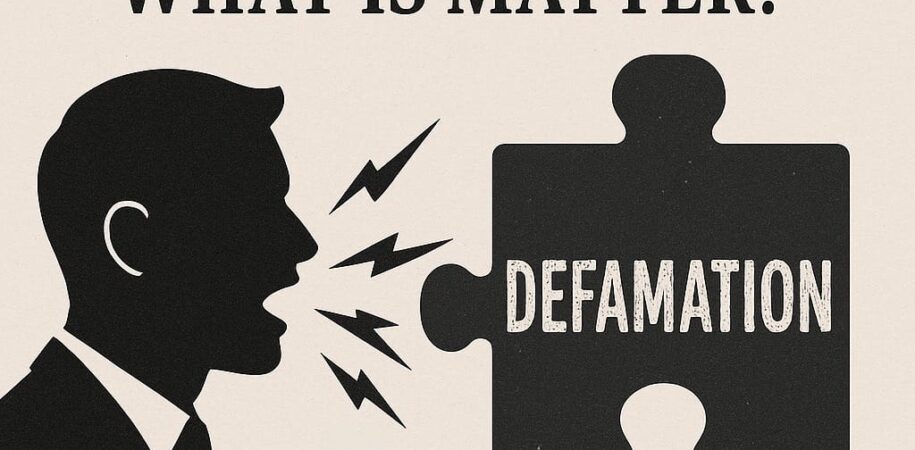
When reading about the law of defamation in an Australian context, or most other common law jurisdictions, such as the United Kingdom, the word ‘matter’ is commonly used. However, what exactly is meant by the term matter when used in the context of defamation?
Well, we at Melbourne Defamation lawyers are here to help, and clear up any confusion which you may have.
For the purposes of this article, we have had regard to the Defamation Act 2005 (Vic) (the Defamation Act), which is the statute governing certain, but not all, aspects of the law of defamation within Victoria.
Section 4 of the Defamation Act (which all States & Territories in Australia have an equivalent, and like, section defining matter), defines matter to include –
- any article, report, advertisement or other thing communicated by means of a newspaper, magazine or other periodical; and
- a program, report, advertisement or other thing communicated by means of television, radio, the Internet or any other for of electronic communication; and
- a letter, note or other writing; and
- a picture, gesture or oral utterance; and
- any other thing by means of which something may be communicated to a person.
As we can see, the definition of matter is extremely broad; it can include any form of written or oral statement, for example, a Facebook or X (formerly Twitter) post, a Whatsapp or Wechat message, any other social media messaging application, a phone conversation, an in-person conversation, a newspaper, a letter or even a book.
If the list of what could potentially constitute matter for the purposes of a claim in defamation, this is broadened even further by subparagraph (d) above, which provides that even a picture or gesture can be considered matter.
However, if that wasn’t broad enough you might think, subparagraph (e) takes what could constitute matter to an entirely different realm, and that is, well, essentially anything can be matter so long as it has the capacity to communicate something to another person. One example of this, could include, for example, a coded message, a symbol or a ritual.
To put it simply, matter is really anything, so long as it is something, and that something is capable of being communicated to another person. Unfortunately, I know that doesn’t help much, but for most defamation claims, it can be better understood as simply words, either oral or in writing. Although the application of defamation law is much, much broader.
Matter – is it important?
The substance and form of the matter is of extreme importance to any defamation claim. Without it, there cannot be a claim. Additionally, the substance of the matter may have effects on the overall case, such as where the plaintiff is not directly identified, but needs to be identified from extrinsic facts, as well as the meaning carried and conveyed by the matter itself.
We examine these particular issues in further detail in separate articles.
If you have been defamed, or you wish to obtain further information or advice on any question concerning defamation in Australia, please contact us by email at lee@cpl.allenlaw.au or alternatively on 0429 070 261, and we will be happy to assist you.
This article is general in nature and is not to be relied upon as legal advice on any subject matter. The article should not be used as a substitute for legal advice from a qualified legal practitioner, as the law could change or may not be applicable your particular matter.
